
Nursing homes require specialized architectural hardware to ensure patient mobility. Proper hardware balances physical accessibility with secure latching mechanics. An ADA door closer prevents noise while meeting safety codes. Careful selection minimizes physical strain on vulnerable elderly residents.
Nursing homes present unique architectural challenges for facility managers. Users include the elderly, wheelchair users, and busy caregivers. These individuals often have extremely limited upper-body strength. Heavy doors restrict their mobility and diminish their independence.
Caregivers need hands-free movement when pushing wheelchairs or equipment. Therefore, facility doors must be very easy to open. At the same time, they must close securely every time. Hardware must balance accessibility with security and strict environmental control.
Standard commercial hardware often fails in these specific environments. Facilities need targeted engineering solutions to solve operational hurdles. Proper specification prevents daily frustration for both staff and patients. Choosing the correct components improves the overall care facility workflow.
Designing for elderly care means focusing on distinct functional priorities. A standard closer cannot handle the diverse needs of residents. Engineers must specify products based on strict operational parameters. Each opening must cater to specific user interaction scenarios.
Maintenance teams face constant challenges in keeping older hardware operational. Upgrading to purpose-built models resolves many of these recurring problems. This prevents unexpected maintenance downtime and improves building safety.
In most cases, the elderly must exert less physical burden when opening doors. A low force ADA door closer for senior care facilities can help in this situation. Those with limited mobility cannot pull heavy doors open. This barrier prevents them from accessing common areas or restrooms.
Interior doors must require five pounds of force or less. Exterior doors typically require 8.5 to 10 pounds of force. A door pressure gauge measures this exact physical requirement. Digital fish scales offer another method to test opening resistance.
Mechanical adjustments modify the closing power without replacing the unit. Rotating the mounting foot or shoe alters the arm offset. Moving the arm towards the hinge side increases closing power. Moving it towards the latch side decreases the overall power.
Doors must close securely to balance privacy and fire safety. Zone management relies on doors latching completely after each use. If a door stays open, fire containment zones instantly fail. Mechanical units use user-generated hydraulic force to shut the door.
The closing speed must not be faster than five seconds. This speed is measured from 90 degrees down to 12. Latching speed must be fast enough to secure the mechanism. However, it must not slam the door against the frame.
Facilities must minimize noise to protect the care environment. Doors that close too fast or too loudly interrupt patient rest. Frequent mechanical noise can add stress and break natural sleep cycles. Pressure differences and worn hardware can also cause heavy slamming.
Through acoustic optimization, the patients’ living experience remains peaceful and restorative. Facility managers must inspect hardware regularly to ensure the internal hydraulics continue operating silently.
Selecting hardware requires strict adherence to documented safety standards. Fire doors demand precise closing mechanisms to contain spreading smoke. Emergency exit doors must allow immediate egress during unexpected crises. Access control for critical areas requires secure, consistent daily latching.
Hardware must pass rigorous independent testing to verify compliance. Some essential international standards include EN 1154 and ANSI/BHMA A156.4. Meanwhile, UL 10C compliance is mandatory for rated fire door assemblies. Compliance can help prevent the unit from premature wear and misalignment.
Managers must also verify factory certifications before installing new facility hardware. These tests replicate decades of real usage scenarios. Testing also confirms the structural integrity of the internal hydraulic components.
Selecting the right model involves checking several essential technical parameters. Facility managers must evaluate the specific daily door function. Incorrect product selection may lead to accessibility problems or safety issues.
Consider the following functional options during the specification process:
The following table shows the common mechanical adjustment settings:
| Setting Symbol | Adjustment Function | Adjustment Purpose |
| S | Swing Speed | Controls the long swing of the door. |
| L | Latch Speed | Controls the short final swing of the door. |
| BC | Back Check | Limits or slows the maximum swing distance. |
Turning the set screw clockwise reduces the hydraulic fluid operating speed. Turning it counterclockwise increases that speed. To prevent adjustment problems, consult the maintenance manual before making hardware adjustments. Modifying the unit incorrectly may void the original manufacturer’s warranty.

The practical door closer for elderly care facility environments should balance ease of use, secure closing, and quiet operation. This specific balance ensures safety while promoting resident independence. OUDE’s door closers can help meet the demands of these senior care facilities.
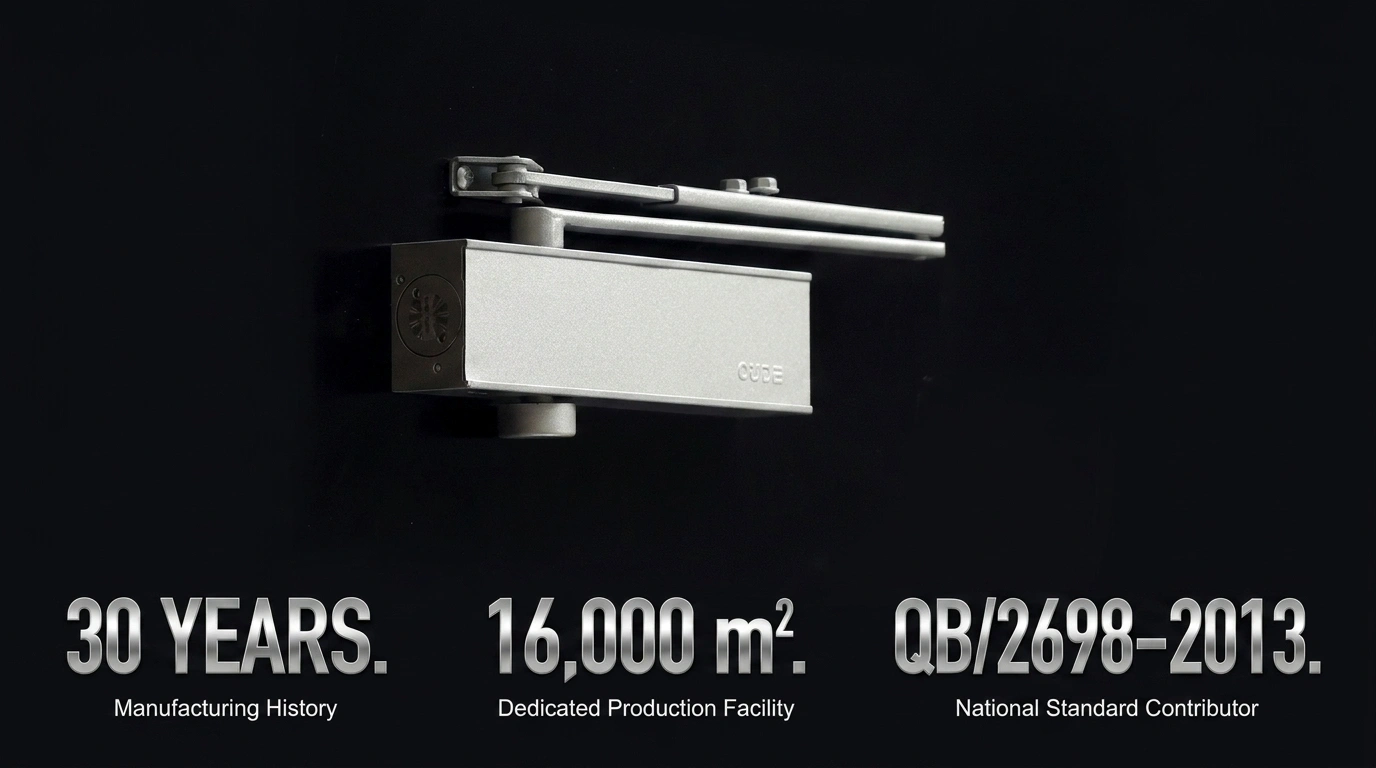
OUDE has 20 years of proven experience manufacturing door closers. Its factory utilizes 16,000 square meters of manufacturing production space. OUDE products hold CE, UL, and ANSI international certifications. Contact OUDE to upgrade your facility with certified door closers or request free samples.





 English
  Spanish
  French
  Arabic
  German
  Portuguese