
More important than a building’s aesthetic finish is its safety and functionality, including door finishes. Managers need to make mechanical stability, especially the UL listed door closer, among the priorities. This guarantees that the building can protect occupants during crises.
Project managers, developers, or architects need to understand that engineering and fire safety codes are crucial for reducing liability and ensuring successful projects. The following sections outline key guidelines for building projects when selecting the right UL door closer suppliers.
Underwriters Laboratories (UL) is the global gold standard in safety science. When a product is labeled as a UL listed door closer, it signifies that the device has undergone rigorous, third-party destructive testing to verify its performance under extreme stress. Unlike standard hardware, a fire door closer must act as a reliable fail-safe. In the event of a fire, the primary function of the closer is to ensure that fire-rated doors return to their latched position automatically after every use.

The self-closing process is the first line of defense in compartmentalizing a building. By keeping fire doors closed, the hardware prevents the “chimney effect,” in which oxygen fuels the spread of flames and toxic smoke through hallways and stairwells. Without a certified closer, a fire-rated door is merely a piece of wood or metal; it is the closer gives the door its life-saving functionality.
Previously, fire tests were conducted in neutral-pressure environments. Building codes today use a more realistic UL 10C standard that includes positive-pressure tests. The shift reflects the reality of how fires behave in retail centers and high-rise buildings, where HVAC systems and heat-induced expansion cause significant pressure imbalances.
UL 10c-certified door closers should observe structural integrity and hydraulic damping force at all times, even when the air pressure pushes the door open. In UL 10c tests, door closers are subjected to temperatures exceeding 1,000°C.
Complying with building code imposed by the Authority Having Jurisdiction (AHJ) is more than just following rules; it’s a legal requirement. For specific hardware types permitted on fire-rated assemblies, refer to the International Building Code and NFPA 80 or the Standard for Fire Doors and Other Opening Protectives.
The installation of a non-certified UL listed door closer can lead to immediate project shutdowns. During final inspections, fire marshals look for the UL stamp on the closer body or arm. If the mark is absent, the building cannot receive its Certificate of Occupancy (CO).
Engineers on large-scale building projects must prioritize manufacturing quality, recognizing that a premium fire door closer is defined by its materials. A high-performance fire door closer is defined by its materials. Quality closers made from an aluminum-alloy die-cast housing and forged steel arms are considered high-quality. Forged steel resists the “bending” or “softening” that occurs at high temperatures, ensuring the door stays closed as the building’s temperature rises.
Another vital feature is the use of high-nitrile seals and all-weather hydraulic fluid. In a fire, the internal pressure in the closed area increases significantly. Inferior seals will fail, leading to “oiling out,” which leaves the door without any closing control. High-nitrile seals are chemically engineered to withstand this pressure and prevent the fluid from leaking, ensuring that the ul listed door closer performs its final, most crucial task when called upon.
Building codes also specify that the closer must be appropriately “sized” for the door it controls. A closer that is too weak will fail to overcome the latch bolt, while one that is too strong may violate ADA (Americans with Disabilities Act) opening force requirements. This is where adjustable power closers offer a strategic advantage. It allows fine-tuning and brings it closer to the exact width and weight of the fire door, including the hallway air pressure.
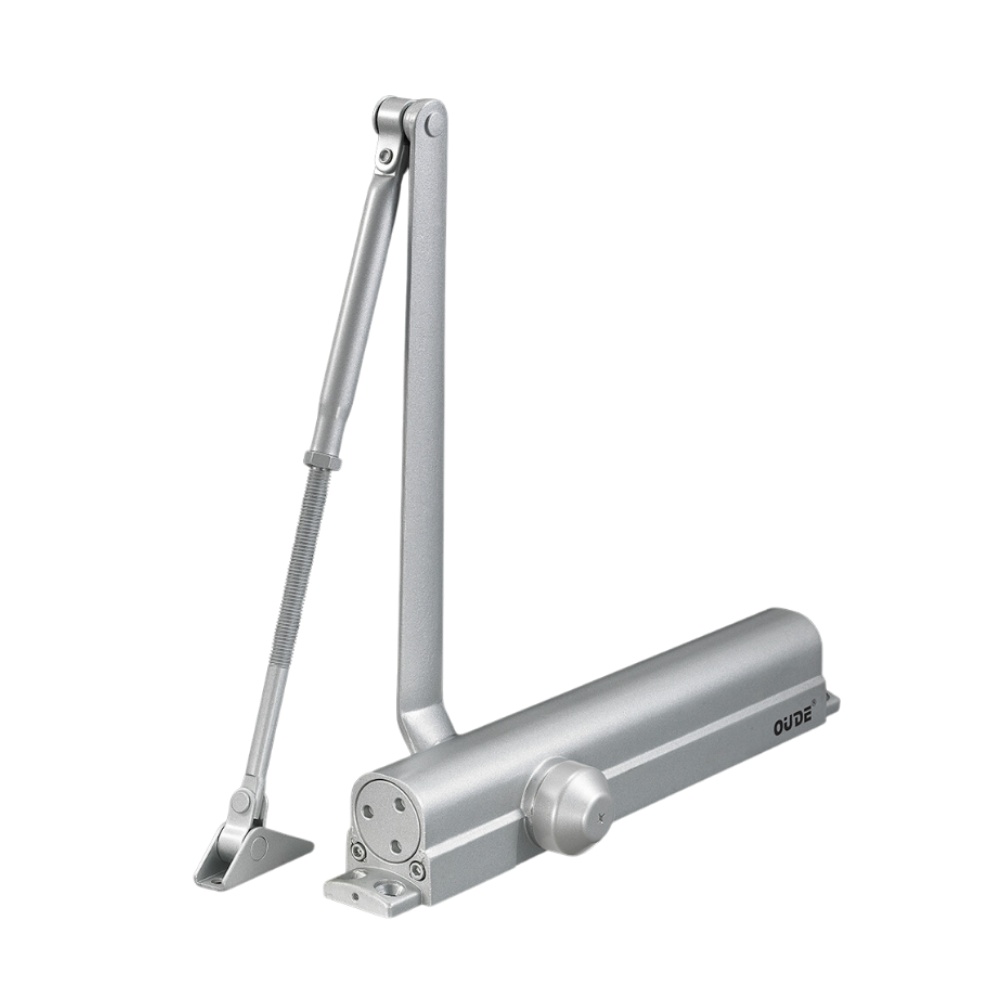
When selecting a supplier, the primary objective is to verify that the manufacturer’s testing documentation matches the physical hardware delivered to the site. A professional closer supplier should provide:
Choosing a UL-listed door closer is a critical decision for procurement managers. As they prioritize products that meet the UL 10C standard, it’s not only about compliance with the law. More importantly, it’s about building a resilient infrastructure. A duly certified fire door closer reduces maintenance costs and prevents failed inspections. Most importantly, it serves as a commitment to safety for everyone passing through these doors.



 English
  Spanish
  French
  Arabic
  German
  Portuguese