
When selecting the right hardware for any commercial, industrial, or residential project, door safety plays a critical role in long-term performance and compliance. One of the most important distinctions installers, distributors, and contractors must understand is the difference between fire-rated vs non-fire-rated door closers.
Although both types support smooth door operation, only fire-rated closers are engineered and certified to perform under heat, smoke, and emergency conditions. Choosing the wrong type can lead to failed inspections, safety risks, and unnecessary replacement costs.
This guide breaks down the functions, certifications, advantages, and applications of fire-rated vs non-fire-rated door closers.
A fire-rated door closer is specifically engineered to hold a fire door closed during emergencies. It undergoes strict laboratory testing to ensure it can resist extreme heat and maintain a controlled closing force.
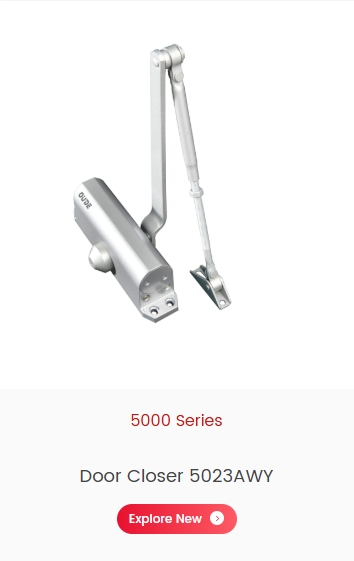
Fire-rated closers must comply with recognized testing standards, such as:
These certifications prove the closure has passed structural integrity, heat resistance, and controlled closing tests.
To meet official fire-rated door closer requirements, a unit must:
Any fire-rated closer must be installed only on a fire-rated door; mixing certified and uncertified components can void the door’s entire fire rating.
Fire-rated closers are mandatory in:
Their purpose is clear: protect lives, slow down fire, and meet building code compliance.
A non-fire-rated door closer focuses on accessibility, smooth operation, and convenience without the heat resistance standards required for fire doors.

Common applications include:
These closers are reliable for daily use, but not suitable for fire doors or emergency exit routes.
One of the main benefits is lower cost. Because these closers don’t require specialized materials or certification testing:
For large-scale projects, non-fire-rated closers can cost savings can significantly reduce the overall hardware budget.
Below is a simplified comparison for quick reference:
| Feature | Fire-Rated Door Closer | Non-Fire-Rated Door Closer |
| Certification | Required (UL/CE/EN) | Not required |
| Heat Resistance | High, tested under fire | Standard operation only |
| Hold-Open Function | Not allowed (unless electromagnetic) | Allowed |
| Cost | Higher | Lower |
| Use Case | Fire doors, emergency exits | Regular interior doors |
| Compliance | Mandatory in rated areas | No fire compliance needed |
Certification marks assure builders, architects, and inspectors that the closer can perform reliably under life-safety conditions.
Certified closers provide:
Selecting the right closer depends on your project’s safety demands, traffic volume, and building codes.
Choosing between fire-rated vs non-fire-rated door closers depends on your project’s safety standards, regulatory requirements, and budget. Fire-rated door closers are essential for any fire door assembly and must comply with UL or EN certification standards. Non-fire-rated closers, on the other hand, offer cost-effective performance for daily-use doors where fire compliance is not required.
By understanding these differences, buyers, contractors, and distributors can ensure safer installations, smoother door operation, and long-term reliability for every project.
Need Reliable Door Closers? OUDE offers certified fire-rated and standard door closers built for durability and smooth operation. Explore OUDE Door Closers.
Q1: Can I install a non-fire-rated door closer on a fire door?
A1: No. Fire doors require certified fire-rated closers. Using a non-rated closer will fail inspection and compromise safety.
Q2: What certifications should I check for fire-rated door closers?
A2: Look for UL 10C, EN1154, CE marking, or ANSI/BHMA A156.4 compliance.
Q3: Are fire-rated door closers more expensive?
A3: Yes. Testing, materials, and certification requirements increase their cost compared to standard closers.
Q4: Do fire-rated closers allow hold-open arms?
A4: Only electromagnetic hold-open systems connected to fire alarms are allowed. Standard hold-open arms are prohibited.
Q5: How long do fire-rated door closers last?
A5: High-quality certified closers typically last 7–15 years, depending on grade, door weight, and usage frequency.









 English
  Spanish
  French
  Arabic
  German
  Portuguese